Sunday, June 24, 2018

England 

May 8 through June 8, 2018

We flew from Madrid to London on May 8.  After claiming our luggage, we worked our way down to the “Tube”, the London subway system that connects Heathrow to major destinations in and around London.  The cheapest way to get around London is to buy an Oyster card that can be used on all public transit.  With two Oyster cards, we were on our way.  An hour or so later we changed to another Tube line, then to a train line which took us within a few blocks of our apartment.  London is a big city.
Clockwise from top left: Tower Bridge, Winchester Cathedral, bronze lion Trafalgar Square, and Westminster Abbey
We enjoyed the most famous sites, but our favorite places are less well known, including the museum and observatory in Greenwich Park.   The spectacular dolphin sun dial greets you near the entrance.  The space between the shadows of the dolphin flukes indicates the time. The museum has exhibits on telescopes, astronomy, and time pieces and links the history of all the different people, discoveries, and instruments that went into establishing the prime meridian and ocean navigation that enabled ocean travel to North America and beyond.
giant ship in a bottle - Maritime Museum

Dolphin Sun Dial: time is at the space between the dolphin flukes
The observatory is centered on the prime meridian, but my cell phone, the most modern navigation tool, shows the actual meridian to be about 100 meters (0.0015 degrees) to the east of the meridian line (zero degrees, zero minutes, and zero seconds).  GPS receivers are based on geodetic longitude, calculations of coordinates for a reference elipse relative to the Earth’s center mass.  The prime meridian is based on astronomical measurements - a position on Earth’s surface relative to the stars and planets.  Hence, they are not exactly equal but I think I’ll be able to live with the difference and knowing I’m never exactly where I am.
Instruments used by Haley and others for astronomical measurements; lining up on the Prime Meridian; the latitude and longitude below the photo are from my cell phone
From London, we headed to Bath, named for the hot springs where the Romans constructed baths a long time ago.
Roman Baths
As well as visiting the Roman baths, we enjoyed walking along the canal constructed to connect Bath and other cities to London.  Barges transported goods between the country and the city, including rocks for building the cathedrals and palaces in London.  Today, the canals are still in use, but mostly for  recreation.  You can rent a long boat and travel between Bristol, Bath, and other cities.  Periodically, the boats pass through locks, the hand operation of the locks has not changed much in well over 200 years.  Anita and I considered becoming lock masters, but the folks on the boats seemed to enjoy the task themselves.
Long boats passing through the locks on the canal
As well as the long boat canal and locks, the River Avon passes through the center of Bath.  Anita and I rented a beautiful wooden row boat and spent a day paddling the river, one of our favorite experiences in England.
Rowing our precious boat on the River Avon
Most of the bird species in Europe have been new to me, but several are the same (house sparrow, common starling) or similar to our own.  The European robin, a fly catcher and not a thrush like our robin, is very friendly and often seen in parks and gardens.  The blackbird (a thrush) is very similar in behavior and shape to our robin.  Even its song is somewhat robin-like.  The crows pretty much look and behave like our crows and the coots are, well, coots.
Clockwise from top left: European robin, blackbird, rook, and coot
If you visit England, I would definitely recommend April-May.  The gardens and country side are abloom with flowers.  Forests are carpeted with bluebells and wild garlic, and bright yellow fields of rapeseed light-up the hills.
One of many gardens, blue bells (lavender) and wild garlic (white) in the forest
We debated visiting Stonehenge, mostly because it has received so much publicity as a tourist stop.  We were glad we decided to go.  We signed up for a private bus that took us to Stonehenge, arranged the entry tickets, and then basically gave us 4 hours to see and do what we wanted.  It is a beautiful location, with trails through hills of wildflowers as well as the Stonehenge rocks.  They have located the quarry for the source of the lintel stones, but they are not sure how they transported such heavy stones over hundreds of miles when all they had was human muscle power.
Stonehenge
We moved on to Lyme Regis by train and arrived on the Jurassic coast.  The town is most famous for fossils, especially ammonites, and Mary Anning, the most famous of the fossil hunters active in Lyme Regis during the early 1800s.
Clockwise from top left: ammonite pavement, location appropriate street lamps, individual ammonite, many ammonites in a beach rock
Although fossils and beaches are the main attraction for mostly English vacationers, we loved the surrounding countryside and the occasional old mill.  There is a restored and active mill in Lyme Regis, where they grind flour to sell.  We enjoyed the cookies and breads made from the flour.
Old Mill
One of the stories told during the mill tour was the origin of the saying: “Show your mettle”.  A long time ago, there were flour mills throughout the English countryside.  The mills all operated basically the same way, with two large circular stones, one turning on top of the other and grinding grain to flour.  Stone dressers maintained the stones for efficient grinding and used metal tools to shape the surface of the stones.  Not all stone dressers, however, were equally good and they lacked internet searches for finding the best.  When a stone dresser showed up at your mill to maintain your stone, the first interchange was: “Show me your metal.” The good stone dresser would promptly role up his sleeves and reveal the scars from years of dressing stones.  You might think ‘mettle’ is a different word than ‘metal’, but until the end of the 17th century, the spelling was interchangeable.

"Then she shewes the metal she is made of."
"To try the spirit of men, of what mettle they are made of."

Who knew?
Clockwise from upper left: the water wheel in action, gears working inside the mill, collecting the flour, extra mill stones (about 5 feet in diameter)
On to food.  We found the food to be really good, including fish (fish and chips, whitebait, cod, plaice, and more), pasties, mash and bangers, and especially the cheddar cheese.  We were told not to miss trying “cream tea”, which consists of tea, a couple of scones, fruit preserves, and clotted cream.  Be forewarned, all clotted cream is not created equal.  We finally hit upon a place, far from the tourist centers, where the clotted cream was something to write home about.  Most of it is like unsalted butter, but the really good stuff is like the difference between canned whipped cream and fresh whipped cream.  Wow!
Clockwise from upper left: bangers and mash, pastie and chips, Warren's bakery, and plaice with asparagus
One of the gems of Lyme Regis is the aquarium located on the Cob.  It is small, but has great information about construction of the Cob, fishing off Cornwall, and local fish.  Our favorite fish included the top knot, a flounder that can suction to the glass sides of the tank (and undersides of rocks), and the bearded rockling that has a constantly vibrating dorsal fin (sorry, I haven’t learned to attach video). The owner of the aquarium has trained an entire tank of mullet to play soccer and come when called.  He has worked with the fish for over 10 years (winters are long in Lyme Regis).
Clockwise from upper left: top knot flounder, bearded rockling, the aquarium on the "Cob", and the famous trained mullet 
Our last stay in England was Falmouth, near the southwestern tip and known for boat-filled harbors, castles (Henry VIII), light houses, and scenic coastal paths.
One of many boat-filled harbors and local ferries
A castle at St. Mawes; light house on the point
Place (that is its name, quite a place) 
Along the spectacular Cornwall coast
We visited several places by bus, an interesting experience in England.  We loved the front seat on the upper deck of the double decker bus, much like flying.  Most interesting are the narrow roads, with vegetation often touching both sides of the bus.  They are use to having to back to a wide spot and let others pass.  We never had a close call.  If Bill and Susan lived in England, the paint on the sides of their pickup would be long gone.
On the bus, from left: a narrow road, on the top deck, another narrow road
We visited the Eden Project near Falmouth, an old clay quarry converted to gardens and giant dome greenhouses, one with tropical plants and another with temperate plants.  The purpose of the project is primarily environmental education, but also tourism.  They have some nice sculptures, including the worlds largest ceramic sculpture of a blue-green bacteria and a giant seed.  The blue-green sculpture produces giant smoke rings that we spent a good half-hour watching (we are easily entertained).  The giant seed is from a single block of granite, weighs 70 tonnes, and took 2 years to carve the 1,800 nodes in Fibonacci spirals.
The greenhouses, outside and inside
Clockwise from top left: blue-green bacteria sculpture, smoke rings, Anita taunts a giant spider, the Seed sculpture
We enjoyed finding signs that showed differences in the use of the English language and a different sense of humor.   Maybe my cousin Carol can appreciate golf balls hit in all directions, but I didn’t know a trail could founder, and we stayed well away from Pendennis Castle during the hours of 12 to 4 p.m.   And how would you like to send your kids to the Crypt Pre-School?

Fly tipping is dumping your garbage in a stream and ‘mind the gap’ is self explanatory when exiting trains and subways.

Possibly not intended to be humorous was the sign at the bottom of the stairs that we walked up to get from the lower part of Falmouth to our apartment.  At the top of the stairs (called Jacobs Ladder) is an inn of the same name.  The inn was always busy serving ale and local brews, especially in the evening.  At the bottom of the very steep stairs (over 200 large steps in all) was a church.  The sign on the side of church may be a message to patrons of the inn that perhaps drank a bit much:  “God brings beauty out of brokenness”.
the impressive stairway: Jacobs Ladder
Our stay in Falmouth sadly came to an end, with its beautiful coast (including tortured rock) and, of course, Nessie lives!, if not in Scotland, at least in Falmouth.
Beautiful tortured and wave-polished metamorphic rock along the coast

Nessie lives!

Sunday, June 17, 2018

Granada, Spain

April 25 to May 8, 2018

Granada was our final destination in Spain, a large city surrounded by beautiful countryside and located within an hour of the Sierra Nevada (home to Spain’s most southern ski resort) and within an hour of ocean beaches on the Mediterranean (we did not make it to the coast, but we could see it from one of the mountain towns we visited).
Outside of Granada, Spain

Sierra Nevada (from Granada, Spain)

Granada, in Spanish, means “pomegranate”.  Consequently, pomegranate trees are seen in gardens and representations are found on the gate to the Alhambra, fountains in the park, posts along the streets, and artwork in the stores.
Gates to the Alhambra with 3 pomegranates on top (left), a fountain with 3 pomegranates on the upper base (right)
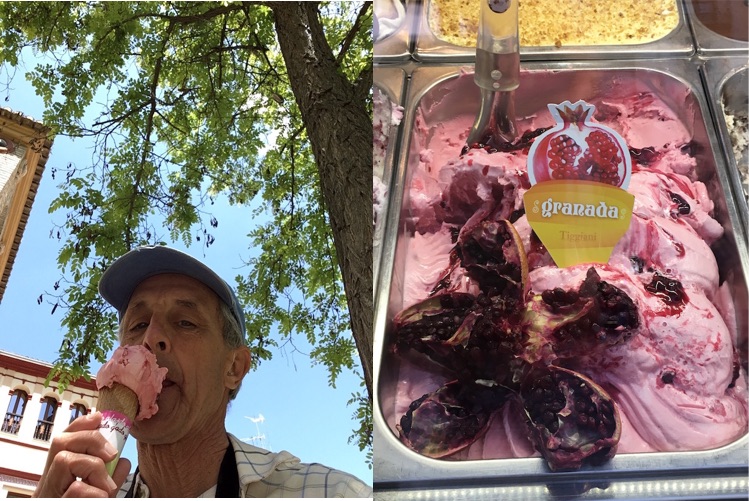
Of course, pomegranate ice cream was one of our favorites.  We enjoyed the wonderful variety of foods everywhere we went in Spain, including octopus soup, tomato and mango salad, pork chops, and wonderful fruit deserts (with pomegranate of course).
Pomegranate ice cream

Clockwise from upper left: octopus soup, tomato-mango salad, pork medallions, fruit dessert
We spent a day walking the hanging bridges of Los Cahorros Monachil, a beautiful narrow canyon with a challenging narrow trail along a stream, especially challenging during the peak of spring runoff.  We also enjoyed hiking around the town of Capileira, another wonderful canyon with a mountain stream, interesting arabic culture, and ibex climbing the cliff faces!  There are so many interesting towns and areas to visit near Granada, we could spend a year and still not discover them all.
Clockwise from upper left: narrow canyon trail, water fall, Anita on the edge, swinging bridge
On one of our hikes, we found the importance of learning the local language and, more importantly, reading the signs.

There are many good reasons to visit Granada, although most tourists travel to Granada to visit the Alhambra, an ancient palace and gardens on the hills above the city.  The gardens are by far the most extensive in Spain and a great place to spend a warm day.  We spent several days and many hours walking pathways through the gardens surrounding the Alhambra.
gardens of the Alhambra
Anita continued to bother insects, getting wonderful photos of bees, flies, beetles, and more visiting the plants in the formal and wild gardens.

When your wife tells you “It will be fine to capture that beetle in the middle of the garden, the paths are there just as a suggested place to walk.”, don’t believe it.

Inside the palace we found more beautiful gardens and very beautifully decorated rooms.  Many folks ask which palace is the most worthwhile to visit - the Alhambra in Granada, Alcazar in Seville, or the palace ruins and bridges of Cordoba.  We would have to say that they are all worth visiting and all of them are unique in and of themselves.  Of all the cities we visited, we would have to say Granada was tops, mostly because of the great variety in the surrounding area, but also the sites in the city itself.
inside a room of the Alhambra 
decorated niche
There are many memorials and statues dedicated to Washington Irving.  He is famous for his “Tales of the Alhambra”.  We have not read the tales, being more familiar with “The Legend of Sleepy Hollow and Rip Van Winkle”, but it now seems that we should.

We truly enjoyed Spain, the beautiful countryside, ancient ruins, and especially the food and culture.  Special artistic touches are everywhere, from intricate pebble designs in the sidewalks to beautifully designed stairs, and wonderful parks.  The Spanish pay attention to artistic detail.  We were sad to leave and enjoyed one more spectacular sunset before heading to London.
Drawing on window, creative stairway, pebble art in the sidewalks

A final touch of beauty over Granada


Thursday, May 24, 2018

El Rocío - April 21 - 25, 2018

We are again a month behind on updating our blog.  El Rocío is a small town adjacent to Doñana National Park, perhaps the most famous of all natural areas in Europe, especially for the diversity of birds.  El Rocío is quite different from other cities in Spain.  The streets are not paved and a grader smooths the sand streets after heavy rains.  The town footprint is much larger than would be expected for 23,000 inhabitants and the majority of buildings sit vacant most of the year.  Walking the sandy streets is a little eery until you get use to it.  The main claim to fame for the town is the annual pilgrimage that occurs at Pentecost, when about a million people (1,000,000!) arrive in the town and every available bed and space is taken.  Every house has a railing in front to tie the horses that transport many of the pilgrims to the town, although many people walk alone with their horses and wagons.  Legend has it that during the 15th century a woodman or hunter found a perfectly carved image of the Virgen, dressed immaculately in white, while working in the woods at this site.  They built a church on the site where the Virgin was kept.  Over the centuries, the Pilgrimage has grown, as well as the size of the church and adjacent places of worship.  You are not allowed to photograph the Virgin.

The Church of the Virgen in El Rocío
The town is very scenic, adjacent to a lake with grassy islands where flamingos and wild horses are seen.

El Rocío from across a corner of the lake
To say the least, other than the week during Pentecost, the town is pretty quiet, attracting tourists that visit the church and surrounding area.  The other attraction to tourists, and the reason for out visit, is the wildlife of Doñana National Park.  The park includes forest and grasslands, but is mostly marsh during the wet season.   One of the attractions is an opportunity to see the Iberian lynx, one of the few locations where they continue to live.   We had seen the road signs warning people to slow for lynxes; cars are a major cause of mortality.  We did not really expect to see one, but were very lucky during an early morning tour into the park.

Anita's photos of the Lynx and a pair of wild boars
Other mammals we saw include lynx food (hares, rabbits, squirrels), deer, black rat, and water vole (another rare mammal).  (Somewhere I read that water vole was an original ingredient of paella, although it may be a rumor started by the English.) After the lynx, birds are definitely the focus of the park and the attraction that brings many visitors throughout the year.  They have constructed wonderful blinds for birders at several locations along the marsh.  In four days we identified over 80 species of birds, but you could easily identify 150 or more with greater effort.

A picture of the inside of a blind for viewing birds and a white stork feeding in the marsh (flamingos are common, but always too far away for photos)
It was nice to see storks feeding in the marsh and nesting in trees.  Previously we had seen them feeding in a town dump and almost always nesting on churches, old buildings, and electrical towers; so it is nice to know they haven't completely forgotten their roots.

As always, Anita took many pictures of insects and flowers.  We have really enjoyed traveling in the spring, with beautiful gardens in the cities and beautiful wildflowers in the country.

A few of the bugs Anita has posted to I-naturalist
some of the wildflowers around El Rocío
Spain is also famous for olives and when traveling by bus or train you often pass through olive orchards as far as the eye can see.  Another claim to fame for El Rocío is the grove of ancient olive trees near the center of town, many several hundred years old, perhaps half a century.  The old olive trees are wild, called acebuches, and are native to the historic forests of cork oak and carob.

Dining and posing under the ancient olive trees and passing alongside an olive orchard on the way to El Rocío
Although the lynx may have been a highlight, the flowers, birds, and history were also enjoyable, not to mention the fabulous food.  We were sad to leave, but excited to be on our way to Granada.


Thursday, May 3, 2018

Sevilla

After an eventful start, including a taxi strike, Anita being sick, and a missed bus, we arrived in Seville on April 13 (Friday, of course).

We stayed at an Airbnb close to the bull ring with Katie, a wonderful woman from England.  She has a lovely apartment on the 3rd floor (4th by U.S. count) and has lived in Spain for over 20 years (the same apartment in Sevilla).

For several reasons, Sevilla is possibly the most beautiful large city in all of Spain, primarily because its history, architecture and life itself centers on the Guadalquivir River.     

The architecture of the old and new buildings is dramatic. Everywhere you go near and even outside the city center, you see beautiful buildings.
Clockwise from top right: Cathedral at night, Cathedral during the day, a church near the river, and sculptures in  niches on one side of the Cathedral
The detail in the architecture is really incredible, including sculpture facings and tile work.  From park benches to railings along walkways, we experienced amazing craftsmanship.
In addition to the above, Sevilla is defined by its gardens in the parks, plazas, and along the river; they are serene and refreshing places to walk.  Whenever we needed a break, a garden was alway nearby and offered a good place to rest.
Clockwise from upper right: tortured trees, a small nook in the garden at the Alcazar, the garden at Plaza de Americas, and even a roof garden near the bus terminal.

Clockwise from upper right: Island of the birds, the mote around the island of the birds, sculptures, and "Fuente de las Ranas", a frog fountain just for Anita.  (All in the park near Plaza de España)
Sevilla is beautiful on its own, and then there are the highlights: the Alcazar (an ancient palace constructed over many centuries and influenced by the various folks in power at the time, including the Arabs, Christians, and others).
The Alcazar is definitely a beautiful place to visit and should not be missed on a trip to Sevilla.  We enjoyed our day learning about the history and viewing all the different forms of architecture.  Another place not to miss is the Plaza de España.  I especially enjoyed visiting during the early morning before the crowds arrived.


The Alcazar is beautiful and full of history, but the Plaza de España is grand, truly a place not to be missed in Sevilla.  As well as the dramatic architecture and spaces, we especially enjoyed the presentations of historic events and maps showing their locations for each of Spain's states (Spain has over 50 provinces or states and each one is represented). The tile work forming the scenes and the maps is incredible.  Beautiful presentations of history.

The 4 presentations of the states that I most enjoyed are shown below.
Clockwise from upper right:  Zaragoza (for its clarity), the Canary Islands (unexpected), Ciudad Real (I just like to see Don Quixote), and Avila (I really enjoyed the battle scene: the men are all wearing armor and carrying shields, but the woman is out there in her nightie leading the charge with her sword raised)

By accident, we arrived during the week of “Feria”, second only to Semana Santa as celebrations in Seville.  The week starts off with the opening of the Feria grounds, where thousands of clubs, families, organizations, and other groups have set up tents where everyone (it seems) in the city meets after 9:00 p.m. for eating fried fish and drinking into the early morning.  We walked through the Feria but left at about 11:00 p.m. so missed the lighting of the thousands of hanging lights that occurs at midnight on Saturday.  The lights will be turned out ceremoniously at midnight on the following Saturday.  

It is truly an amazing event.  The tents are set up and taken down every year and most amazing of all is the entrance to the Feria, a huge arch that is designed and constructed uniquely every year.
Clockwise from upper right: the tents at night, tables and chairs inside one of the tents (many were more elaborate than this), and of course the various rides that make it a fair for children and adults alike.

Clockwise from upper right: the entrance to the Feria (note the trucks driving through - not a small structure), the tents during the morning after everyone has gone home, and venders refurbishing the wine, soda, and beer for the coming night - 5 nights to go!

The Feria is quite the party and includes many daytime activities:  bull fights every day for a week (we didn't attend) and a parade of horses and carriages representing various families and organizations from Sevilla.  We attended the parade of carriages in the bull ring, the only opportunity to see them in one place (you could see them around town throughout Feria week).
Andalusia (southern Spain, is famous for its beautiful and well trained horses.  The horses circling were from Mexico, this years invited guest.
We visited an exhibition highlighting the work of Van Gogh.  There was none of his original work, but it was a fun exhibit of lights and sound explaining both his life and his work.  We liked the Sevilla touch: a flamenco dress with the starry night motif.  


On one of my morning walks, I discovered this incredible (for its enormous size and topic) sculpture.  Columbus met with Queen Isabella in Sevilla (at the time, the capital of Spain) and Queen Isabella funded his voyage that ended with the discovery and ultimate European settling of America.  The sculpture is called "Huevo de Colón" or Egg of Columbus, representing the hatching of the event that led to the colonization of America.  The giant sculpture was part of the World Exposition in the 1990's.  
I especially liked the sash with the Niña, Pinta, y Santa Maria sailing to America
The food continues to be fantastic in both flavor and presentation.  The food below represents an appetizer (coquina clams in garlic and olive oil), 1st course (garbanzo beans and spinach), main course (cod and shrimp cooked to perfection), and a pastry (beautifully decorated).

Finally, it would not be right to not mention the famous Spanish hams, hanging in all the good bars and restaurants throughout Spain.  I have to say, I have enjoyed the ham and it is very different than ham in the states, much dryer and variable in taste depending on the region.  You can get American ham, but why?  The restaurant the other day had run out of Iberian ham, tragic.  I love the special holders for cutting each ham.  Once cured they seem to be able to hang them anywhere, ready for eating.
Note the hams hanging behind the gentleman cutting slices from a leg.